
You Should Get Ducks. She Chose Frogs.
Everyone on our side of the room could see the obvious answer.
Nobody said it.
My husband Clint is doing an internship with A Bigger Table Asia this summer, as part of his Rotary Peace Fellowship. He has over twenty-five years in the humanitarian sector.
I think we can all agree he has enough field experience. But here we were, and I have to say, it has been such an amazing summer.
A Bigger Table Asia is a Lao social enterprise and US 501(c)3, founded by Jeff and his wife, who bring years of experience in the humanitarian sector. Their model is simple and, in the humanitarian sector, genuinely rare.
They give cash grants directly to survivors. Not goods. Not a plan designed by outsiders. Cash, to the people who need it, to use as they decide.
A small initial grant, a follow-up at thirty, sixty, or ninety days to see how it was used, and if the family has done what they said they would do, another grant could follow.
They arrive with questions and cash: what do you need, and what will you do with it?
It is not charity. It is a grant for self-determined change.
Forty-eight hours after arriving in Vientiane (which almost didn't happen due to passport issues, but that story is in my next blog), we were on a plane to Savannakhet, then in a car heading east toward the Vietnamese border.
We were on our way to meet Noi.
Noi had been injured by unexploded ordnance from a war that ended fifty years ago, while farming.
She is a farmer, not an entrepreneur.
She lives with her sister and cousin, their three houses clustered together in a remote village a three-hour drive from Savannakhet.
We sat down with Noi, her sister, and her cousin and asked how we could help Noi support herself and her young children now that she can no longer farm.
She told us she had no idea what she could do.
Everyone on our side of the room thought we knew the answer. Ducks. Maybe a roadside stand. Fish. Any of us could have listed five options in thirty seconds.
Clint, who comes from a construction background, looked around and saw a roof that needed fixing and a foundation that needed attention. He didn't say anything. Those were his ideas, not theirs.
La, a Lao social entrepreneur who translated for us, didn't share any ideas either.
She asked Noi what she wanted to try. Then she asked her sister and cousin to think about it and let us know the following morning.
I sat there watching the whole discipline of coaching play out in a village I had never been to, in a language I don't speak. Not telling. Not rescuing. Not offering the obvious. Just asking, and trusting the answer to come.
We came back the next morning.
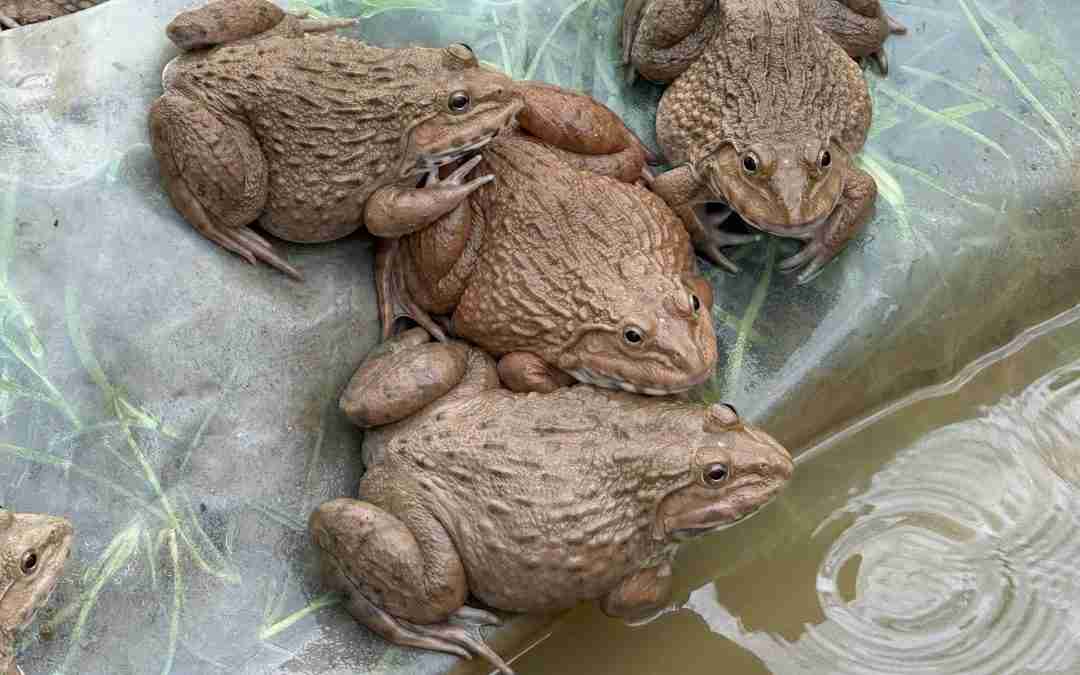
They chose frogs.
Frog farming. A pond, a small initial stock, a business the family could manage together across their three clustered houses.
This business would feed their families essential protein and then sell fried frog legs to the tourists passing by on the road. The sister and the cousin were part of the decision. This was not one woman's project. It was a family enterprise.
They also asked whether stairs could be added to Noi's house. She had been essentially using a ladder. And whether there could be some money to fix the latrine her father had built over twenty-five years ago.
The total grant was around $530.
Frogs, new stairs, latrine repair, and a plan for the water source. Every item on the list came from the family. Not one idea came from us.
We said our goodbyes and drove back to Savannakhet.
Forty-eight hours after we left, pictures came through. The frogs had arrived. The stairs were built. Nobody had followed up to remind them.
We didn't check-in to make sure they were on track. They had the resources and they knew exactly what to do with them.
In the same forty-eight hours it had taken us to go from arriving in Vientiane to being on a plane to Savannakhet, this family had already started building their future.
Thirty days later, Clint, Jeff, and La made the follow-up visit. I stayed in Vientiane and waited for the photos.
The frogs are thriving. The steps look great in person. There is a new latrine. In thirty days, this family had done everything they said they would do with the money they were given.
Not because anyone supervised them. Not because anyone checked up on them. Because this is what they actually needed, and they knew exactly what to do with the means to get it.
And then there were the bananas.
While La was arranging the thirty-day follow-up visit, a conversation about fried bananas came up. The cousin was immediately interested, excited enough to travel to Savannakhet to be trained on how to fry bananas.
When Clint and Jeff arrived, she was already there, learning, ready to take her new skills and her equipment back to the village.
I received the photos that morning. The family was already at it before the team had even arrived.
Needless to say, there might have been a few upset tummies from eating fried bananas all morning!
Nobody asked her to do this. Nobody included it in the initial grant. It grew out of the first conversation the same way everything else had: someone asked what was possible, and the family kept finding more answers.
This is what A Bigger Table Asia does that most organizations don't.
They asked what the family needed. They gave them the resources to do it. They came back to see what happened. And then they asked again.
The frogs were not our idea. The specific repairs were not our idea. The bananas were not our idea.
Clint saw a roof and a foundation that needed fixing. He kept that to himself, because those were his ideas, not theirs. What this family needed was not someone else's construction priorities. It was the resources to act on their own.
People don't want to do other people's ideas. They want to do their own.
That is not just a coaching principle. It is what the difference looks like between a family that receives a handout and a family that receives a grant. One is given a solution. The other is given the capacity to find their own.
I coach humanitarians and professionals in high-pressure environments, integrating ICF coaching with functional movement, because recovery happens in the mind and the body. Let's talk.
And if you're not ready to talk yet, start with The Mission Reset, the tools I used in Bangladesh to stay sane.
What do you want next?
Whether your answer is to set new boundaries or make a change, make sure your decision comes from a place of true clarity.
Download The Mission Reset for a 5-question audit and five daily well-being practices designed specifically for humanitarians and professionals in stressful environments.